The Tinkla project
History of boggyver's Tesla Unity openpilot fork — the origin of pre-AP openpilot support and direct predecessor to NotAutopilot.
Updated June 11, 2026
This page documents the Tinkla project for the historical record. Tinkla (tinkla.us) is no longer active. It is not part of a current NotAutopilot install — for that, start at /getting-started/install.
Background
Tinkla was the work of one developer who went by the handle boggyver. His day job involved embedded systems and cybersecurity; his commute involved a 50-mile stretch of congested Pennsylvania interstate in a pre-Autopilot Model S. He found openpilot around version 0.4.2 and started asking whether it could run on his car — a vehicle Tesla had never equipped with any driver assistance hardware.
The answer was not obvious. Pre-AP Model S cars have an electric power steering column (EPAS) that accepts CAN commands, but there is no DAS computer, no radar, and no windshield camera mount. Making openpilot work meant reverse-engineering the steering CAN interface, emulating enough DAS traffic to keep the car's safety systems satisfied, and building every piece of physical hardware from scratch. He documented the process on a MediaWiki site called Tinkla — short for "Tinkering with Tesla" — and kept updating it as the hardware and software evolved through 2018 to roughly 2024.
The project also won the Car Hacking Village competition at DEFCON 27 in August 2019, where boggyver was part of the CANucks team.
What Tinkla supported at its peak
By 2022–2023 the Tesla Unity branch of openpilot covered four car categories:
- Pre-AP Model S (2012–2014): no factory ADAS hardware; openpilot drove the EPAS column directly.
- AP1 Model S (2015–2016): MobilEye-based hardware; openpilot coexisted with factory AP, with single-stalk for OP and double-stalk for factory AP.
- AP1 Model X (2016): same AP1 hardware, support added later than Model S.
- AP2/2.5/3 Model S/X (2016 onward): Tesla hardware 2; openpilot handled lateral plus optional openpilot longitudinal.
Model 3/Y support was in development when the project paused (a complex three-CAN harness was in manufacturing as of early 2024).
Hardware products
Tinkla sold several physical products alongside the software:
- OBD-C adapter — plug-in adapter for the driver's footwell OBD2 port, replacing the old EPAS harness for pre-AP cars. Details: EON-era hardware.
- Tinkla Buddy — man-in-the-middle device for instrument cluster integration on MCU1 cars. Details: Tinkla Buddy.
- Comma Pedal (Tesla firmware) — the standard comma.ai interceptor, flashed with Tesla-specific firmware, sold or configured through Tinkla.
- Radar kit — aftermarket Bosch radar retrofit for pre-AP cars; first batch available January 2023.
- Tinkla Relay — a four-relay CAN-listening board for controlling accessories via steering-wheel button combinations, usable on any Model S/X/3/Y.
How the install evolved
2018 — frunk teardown era
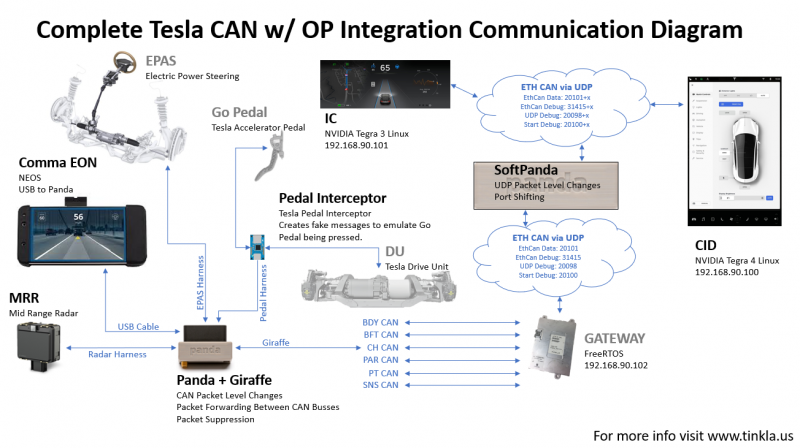
The first working pre-AP install required opening the frunk, drilling through the firewall, and routing a hand-made EPAS wiring harness from the EPAS connector in the engine bay through to the cabin OBD2 port area. The comma device at this point was the EON — a modified Android phone in a 3D-printed windshield mount — talking to a white or grey Panda OBD dongle via USB. Settings were changed entirely over SSH.
The Tesla Giraffe, designed by a community member known as appleguru, was a small PCB that plugged into the OBD2 port and routed the chassis CAN, EPAS CAN, and radar CAN to the Panda's three CAN buses. For cars built before May 31, 2013, the Giraffe needed an additional "TDC connector" because those cars lack chassis CAN on OBD2 pins 1 and 9.
2019–2021 — IC integration and SoftPanda
Boggyver was told that emulating DAS messages so the instrument cluster would display the openpilot AutoPilot view was impossible. He shipped it anyway. SoftPanda was the first approach: a binary that ran on the CID (central infotainment display) over SSH and proxied EtherCAN packets between the MCU and IC, rewriting them to make the IC think a DAS was present. SoftPanda required root access to the Tesla's internal computers.
When Tesla started locking down MCU1 to prevent root persistence, SoftPanda became harder to maintain. That prompted the Tinkla Buddy, a hardware MITM device described on its own page.
2022 — OBD-C adapter, comma three, and the modern era
Version v0.8.13-31 (March 2022) marked the start of the current-style install. The Tinkla OBD-C adapter replaced the EPAS harness entirely — it plugged into the driver's footwell OBD2 port and presented the right CAN connections to the comma device over a Thunderbolt3/USB4 cable. No frunk work. No drilling. Settings moved out of SSH config files into a UI panel on the device.
The same release added comma three support and required an EON Gold or black Panda at minimum. Shortly after (v0.8.13-38, April 2022), comma three was fully supported and became the recommended device.
Development timeline
The table below picks out releases that changed the install meaningfully. The full changelog was on the Tinkla wiki main page.
| Version | Date | Milestone |
|---|---|---|
| ~v0.6.6 | ~2018 | First pre-AP install on EON + white panda + EPAS harness + Giraffe |
| ~v0.7.4 | ~2019 | Last EON-compatible release; SoftPanda IC integration |
| v0.8.13-31 | 2022-03-18 | OBD-C adapter replaces EPAS harness; all settings in UI; comma three support |
| v0.8.13-38 | 2022-04-05 | Comma three fully supported; C3 splash screen |
| v0.8.13-41 | 2022-04-19 | C3 modem initialization fix |
| v0.8.13-43 | 2022-04-21 | iBooster ECU first working firmware; Vacuum Sensor board |
| v0.8.13-56 | 2022-11-08 | 5 pedal profiles; iBooster refinement; lane poly for IC; brake factor tunable |
| v0.8.13-57 | 2022-11-17 | Speed-limit-adjusted top speed for AP1; RHD set-speed display |
| v0.9.6-61 | 2024-01-17 | C3X support; stalk-selection for OP/AP1/ACC on AP cars; improved IC data |
After v0.9.6-61 the project effectively went quiet. The tinkla.us domain stayed up for a while and then went offline.
057 Technology and HV battery warranty
One concern in the community was whether transmitting on the Tesla CAN would void 057 Technology's HV Battery Service Plan, which explicitly prohibited third-party CAN devices. Boggyver confirmed with 057 that the Tinkla Unity branch did not touch the Powertrain CAN, and 057 agreed it would not void their plan for that specific hardware and software combination. That guarantee did not extend to other branches or modified configurations. 057 later went out of business, leaving tons of owners with warranties that never did anything.
Lineage to NotAutopilot
After Tinkla went quiet, xnor-tech continued AP1 work in a separate openpilot fork at https://github.com/xnor-tech/openpilot. NotAutopilot took up the pre-AP side: it is based directly on mainline comma.ai openpilot, with a dedicated panda safety mode (tesla_preap), an install via the standard comma installer on comma 3/3X/4, and ongoing development. The hardware connection still runs through the OBD2 port via the OBD-C adapter, same as the late Tinkla era.